Procédure
Prerequisites for installing a new site on your VPS server
To add a website, you first need a domain name.
A domain name is a "mask" on an IP address. The purpose of a domain name is to easily remember and communicate the address of a set of servers(website, email, FTP, etc.). For example, google.com is easier to remember than 142.250.185.164.
How do I order a domain name?
Find out here how to order a domain name
How do I add a website to ISPconfig?
We assume that your domain is active and that you have already modified the A record field of your domain name on the server
1. Go to your ISPCONFIG panel
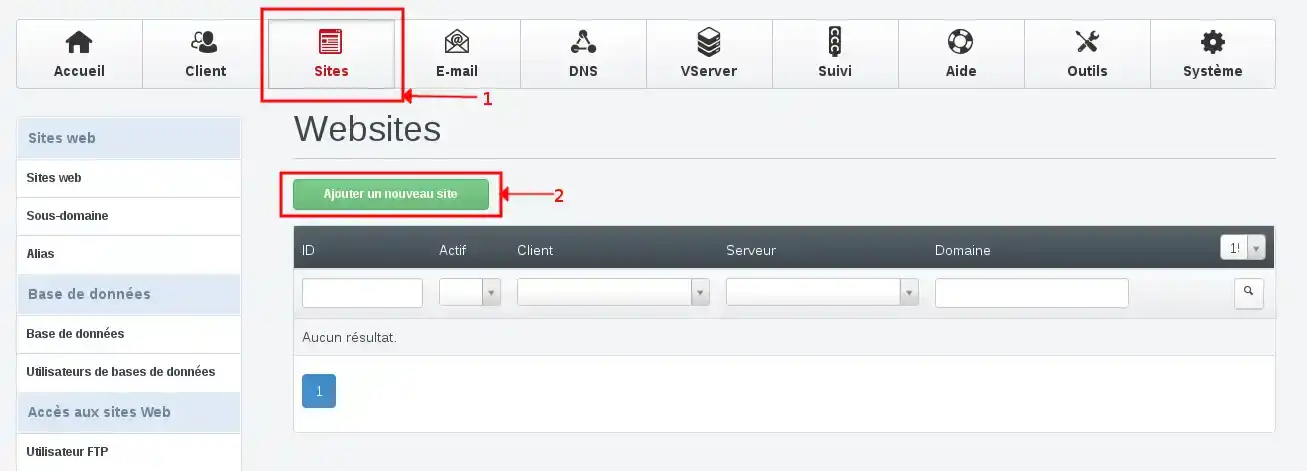
2. Click on the "Sites" tab and then on the "Add a site" button.
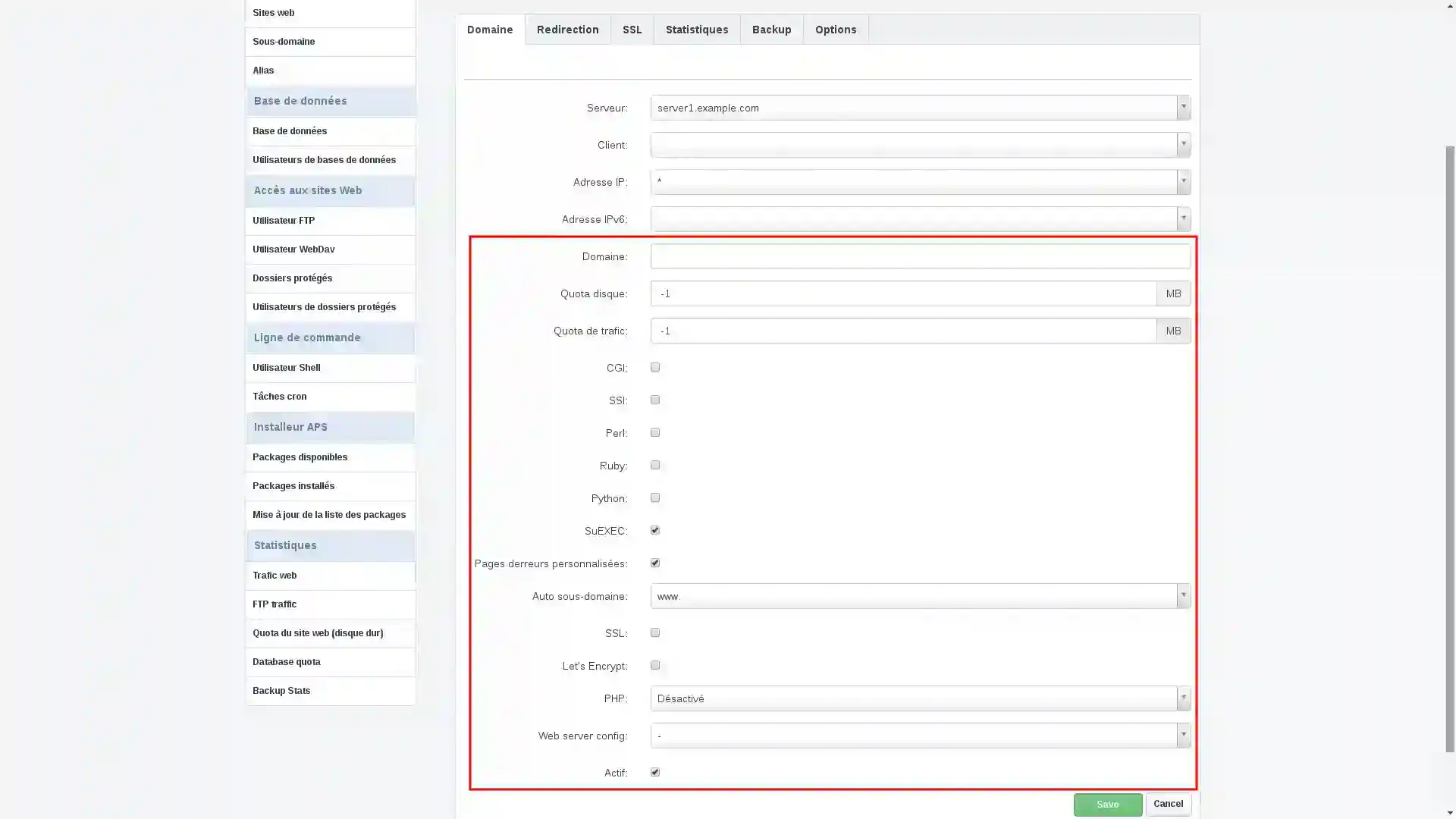
3. Complete the fields defined in the red square.
In most cases, you just need to validate the domain name and then click on "Save".
Be careful not to choose FAST-CGI in the PHP section. This feature may cause compatibility problems with some sites. Preferably choose PHP-FPM or MOD-PHP.
If you wish to limit the disk space used by your site, fill in the Disk Quota section with the number of MB required. Only this section allows you to make this restriction. The equivalent section in the FTP user creation form is not active.
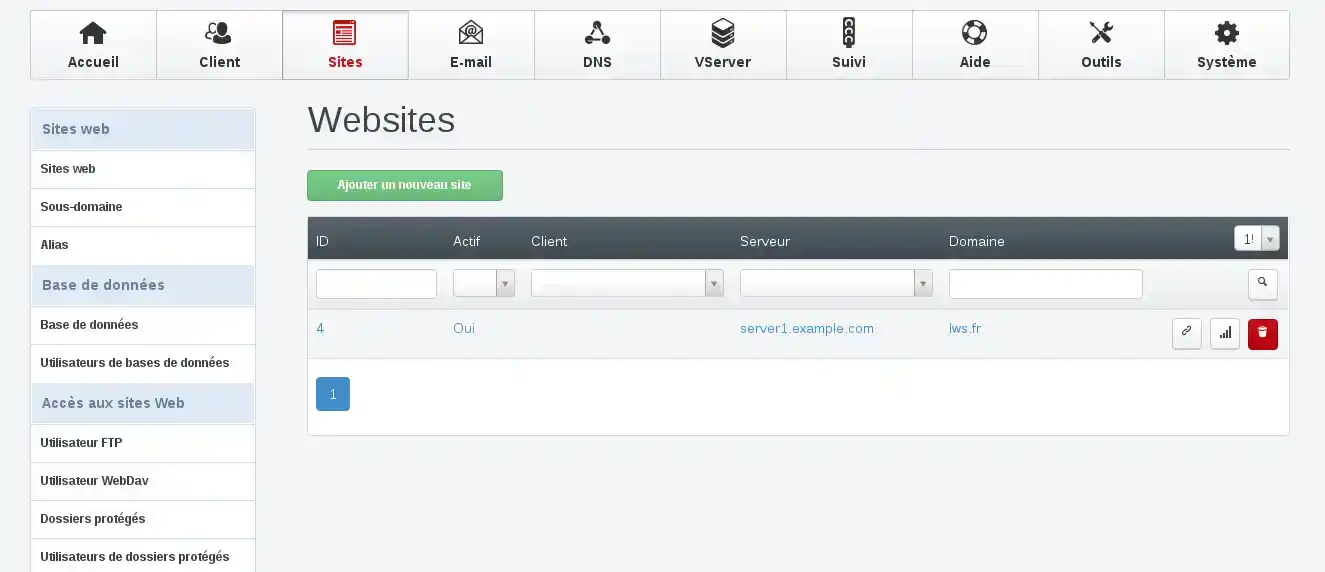
4. After registration you should see this screen:
How do I link my domain name to my VPS dedicated server?
We have prepared full documentation on this subject: How do I link my domain name to my VPS server?
Video procedure
Why isn't the domain automatically added to my server?
When you order a domain name, it is not automatically linked to your VPS, as each domain comes with 2 GB hosting without PHP and the option of creating 1 email address.
You therefore need to tell your domain that you are not using the default configuration but that of your VPS.
What do disk quota and traffic quota mean?
Disk quota is the space you wish to allocate for the site
Traffic quota is the traffic allocated for this site. We recommend that you leave this value unchanged.
These two values default to -1, which means no limit.
What are CGI, SSI and SuEXEC?
CGI (Common Gateway Interface), SSI (Server Side Includes) and SuEXEC are three modules of the Apache service.
For more information, see the official Apache documentation.
What are Ruby and Pyhton?
Ruby is a free programming language. It is interpreted, object-oriented and multi-paradigm. The language was standardised in Japan in 2011 (JIS X 3017:2011)2, and in 2012 by the International Organisation for Standardisation.
Python is also an object-oriented, multi-paradigm, multi-platform programming language. It supports structured, functional and object-oriented imperative programming. It features strong dynamic typing, automatic memory management using garbage collection and an exception handling system, making it similar to Perl, Ruby, Scheme, Smalltalk and Tcl.

 Contact us
 Customer Area
 Visit LWS


 Yes
Yes No
No Article read
60553 once
Article read
60553 once Merci ! N'hésitez pas à
poser des questions sur nos documentations si vous souhaitez plus d'informations et nous aider à les
améliorer.
Merci ! N'hésitez pas à
poser des questions sur nos documentations si vous souhaitez plus d'informations et nous aider à les
améliorer.
 About
About