Contact us
 Customer Area


 Visit LWS
Rate this article :
2.9/5 | 10 opinion
This article was useful to you ?
 Yes
Yes
 No
No
 Article read
40228 once
Article read
40228 once Merci ! N'hésitez pas à
poser des questions sur nos documentations si vous souhaitez plus d'informations et nous aider à les
améliorer.
Merci ! N'hésitez pas à
poser des questions sur nos documentations si vous souhaitez plus d'informations et nous aider à les
améliorer.Vous avez noté 0 étoile(s)



Sommaire
Procédure
Service concerned: LWS VPS server
Panel concerned: ISPConfig 3
Level: beginner
An SSL certificate allows you to access your site with an address starting with https:// and encrypts communication between the site and its visitors.
ISPConfig can generate a free Let’s Encrypt certificate for a site already configured on your VPS. The certificate will then be renewed automatically, provided that the domain continues to point correctly to the server.
This help applies to VPS servers using ISPConfig.
Are you using another environment?
The site must already have been added in ISPConfig.
The domain name must also point to your VPS IP address. [PERSON_NAME] with www, it must also point to the server.
Do not enable Let’s Encrypt immediately after a DNS change. Wait until propagation is complete.
If the domain does not yet point to the VPS, ISPConfig will not be able to generate the certificate.
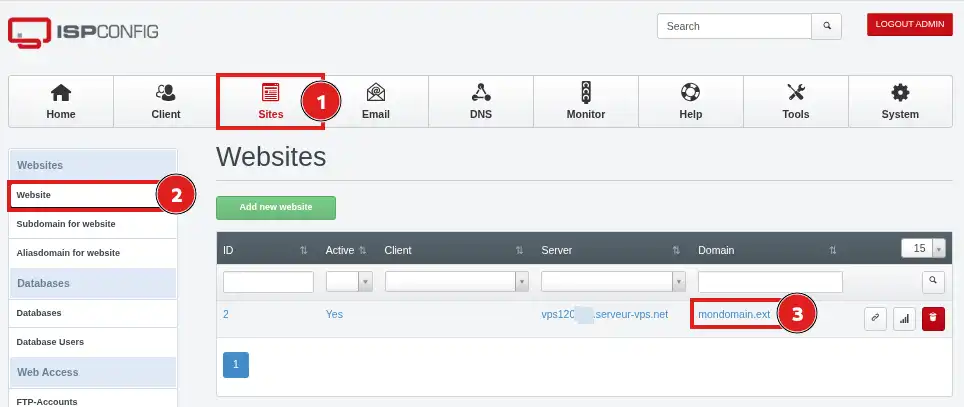
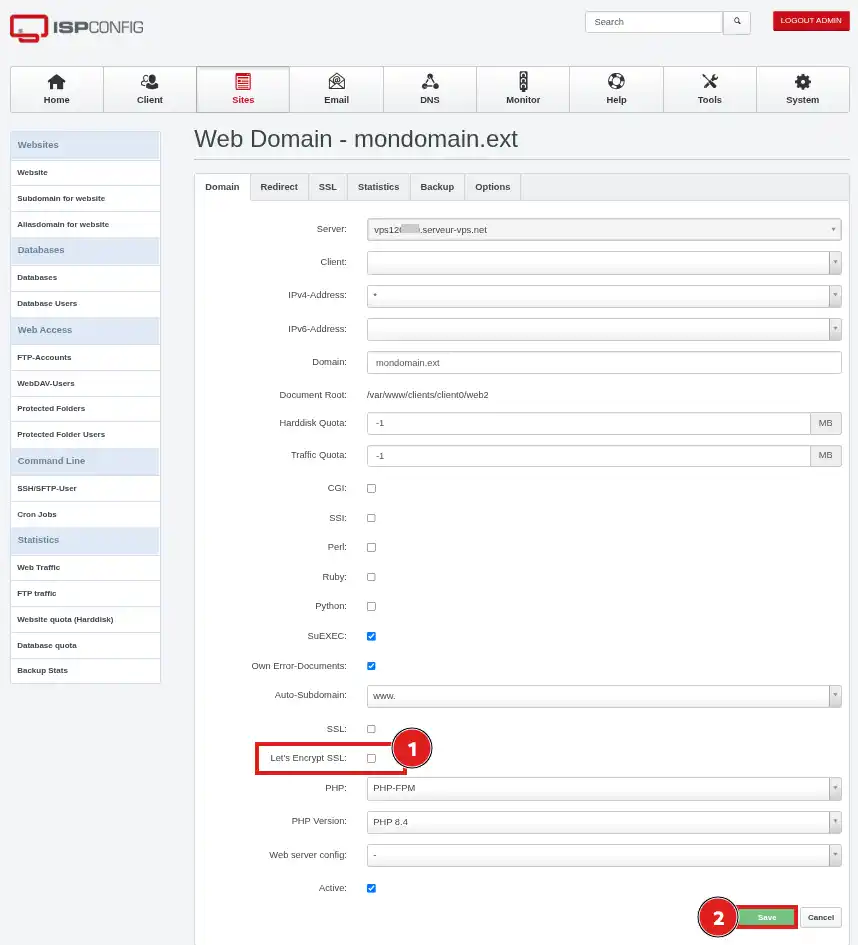
www if your site must be accessible with and without www;www if this address is not configured in your zone [ADDRESS]>
ISPConfig then starts creating the certificate. The operation may take a few minutes.
Open your site in a new tab using an address starting with https://, for example:
https://your-domain.com
[PERSON_NAME] configured [PERSON_NAME] www, test it separately:
https://www.your-domain.com
The certificate is correctly installed when the site opens in HTTPS without a security warning in the browser.
Installing the certificate makes HTTPS available, but it does not redirect [PERSON_NAME] http://.
To automatically force HTTPS usage, you will need to set up a script (.htaccess) or a plugin (if using a CMS) to perform the automatic redirect.
The Let’s Encrypt certificate is automatically renewed by ISPConfig. No manual intervention is required as long as the domain remains correctly configured and accessible from the VPS.
The Let’s Encrypt option [PERSON_NAME]>
[PERSON_NAME] usually means that ISPConfig was unable to generate the certificate. Check the following points: After correcting the pointing, check SSL and Let’s Encrypt SSL again, then save. The site works without www, but not with www The Check the A certificate warning appears in the browser Check that you are viewing exactly the domain name for which the certificate was created. A certificate generated only for My site remains accessible over HTTP This behavior is normal if no redirect has been configured. The certificate enables HTTPS, but does not automatically force its use. Set up a permanent redirect from HTTP to HTTPS to send all visitors to the secure version of the site. HTTPS works, but some resources are flagged as insecure [PERSON_NAME] site is probably still loading images, scripts, or stylesheets with addresses starting with Replace these addresses with their
www also points to the VPS if it is enabled in ISPConfig;www address probably does not point to your VPS or was not included in the site configuration.www DNS record, [PERSON_NAME] ISPConfig.your-domain.com does not necessarily cover www.your-domain.com, and vice versa.http://.https:// version or correct your application’s configuration.
Rate this article :
2.9/5 | 10 opinion
This article was useful to you ?
Yes
No
2mn reading
How to use [PERSON_NAME] with ISPConfig?
3mn reading
Diagnose and correct a 500 error on a VPS with ISPConfig
13mn reading
[PERSON_NAME] his site on a VPS server with ISP Config
 About LWS :
LWS is a 100% French web hosting company that focuses on quality and innovation and offers a responsive and competent technical service at affordable prices.
About LWS :
LWS is a 100% French web hosting company that focuses on quality and innovation and offers a responsive and competent technical service at affordable prices.