
Online help
The web host accessible to all
Procédure
Service concerned : domain names
Panel concerned : no specific panel
Level : beginner
A domain name is the address visitors use to easily access a website, for example lws.fr or example.com.
It can also be used to create custom email addresses, such as contact@example.com, or subdomains, such as blog.example.com.
This guide simply explains what a domain name is, how it is structured, and what it can be used for.
A domain name replaces a technical address that is hard to remember with a simple, readable name.
For example, it is easier to remember:
example.com
than an address made up solely of numbers or technical information.
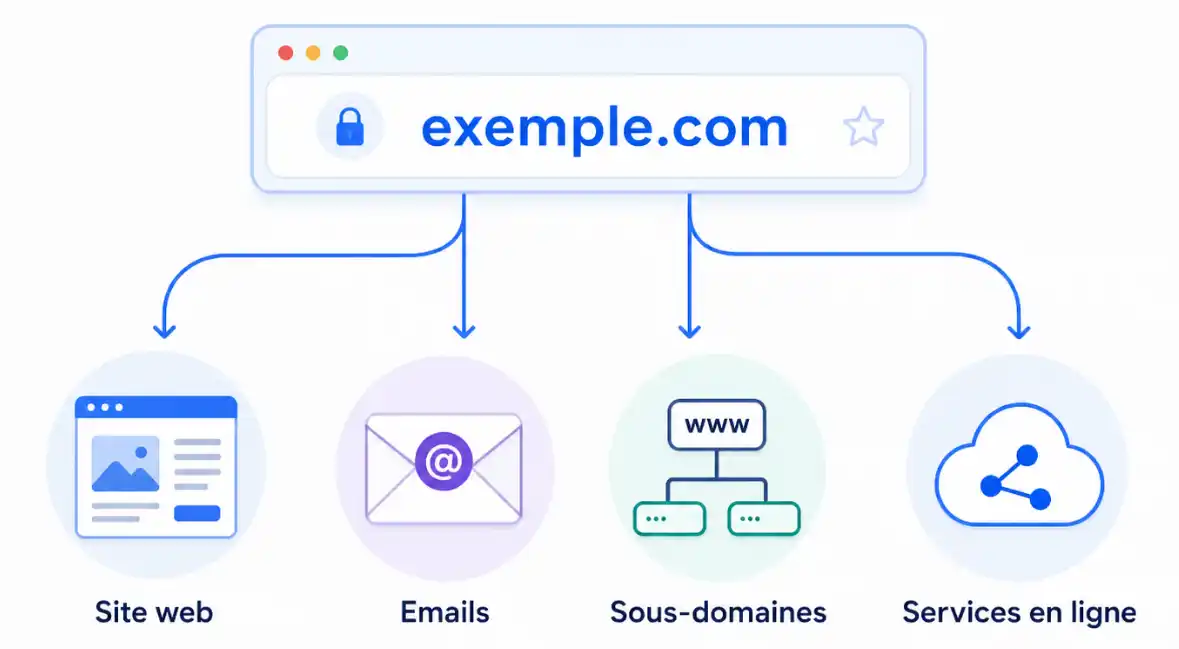
A domain name can be used to:
A domain name does not automatically create a website. The domain serves as the address. Web hosting, on the other hand, is used to store the site’s files.
A domain name is generally made up of two main parts:
example.com
In this example:
example is the chosen name;.com is the extension.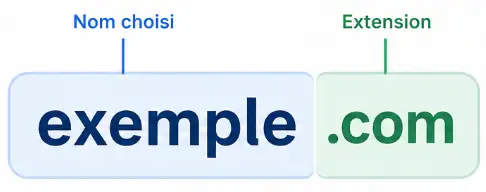
The extension may correspond to a country, such as .fr, to a common use, such as .com, or to a more specific category depending on the type of project.
A domain name must be unique within its extension. For example, if example.com is already registered, someone else cannot register exactly the same domain in .com.
It is common to confuse these elements when you are getting started.
In the address blog.example.com :
example.com is the main domain name;.com is the extension;blog is the subdomain.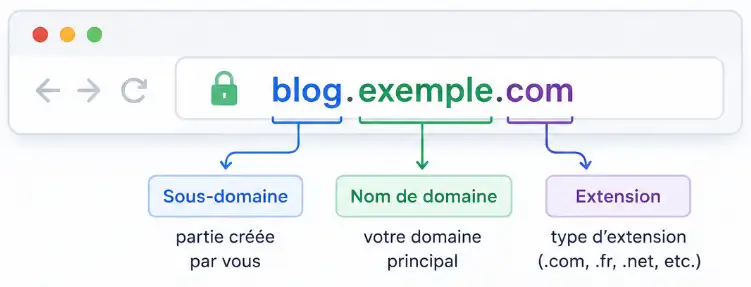
A subdomain makes it possible to create a separate address from a main domain.
For example, with the domain example.com, you can create:
www.example.com for the main site;blog.example.com for a blog;boutique.example.com for a store;support.example.com for a help area.The subdomain remains attached to the main domain name.
A domain name can also be used to create custom email addresses.
For example, if you own the domain example.com, you can create addresses such as:
contact@example.com ;first.last@example.com ;support@example.com.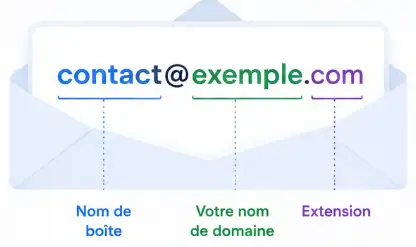
This allows you to use a more professional address than a generic free email address.
For these addresses to work, the domain must be associated with a properly configured email service.
To use a domain name, you must first check that it is available, then register it with the desired extension.
When placing the order, you choose:
.fr, .com, .net or .eu ;Registering a domain name does not automatically protect a trademark in the legal sense. It mainly prevents someone else from registering exactly that domain in the same extension as long as you keep it and renew it.
A domain name must be renewed before it expires in order to remain active. If renewal is not completed on time, the domain may be deactivated, then become available again depending on the rules of its extension.
A domain name is the main address that makes it easy to identify a website, an email address, or an online service.
It can be used on its own or with subdomains, and it must be connected to the right services to work: web hosting, email, an online store, or another external service.
Ask the LWS team and the community. Answers are published after moderation.
 About LWS :
LWS is a 100% French web hosting company that focuses on quality and innovation and offers a responsive and competent technical service at affordable prices.



 Yes
 No